
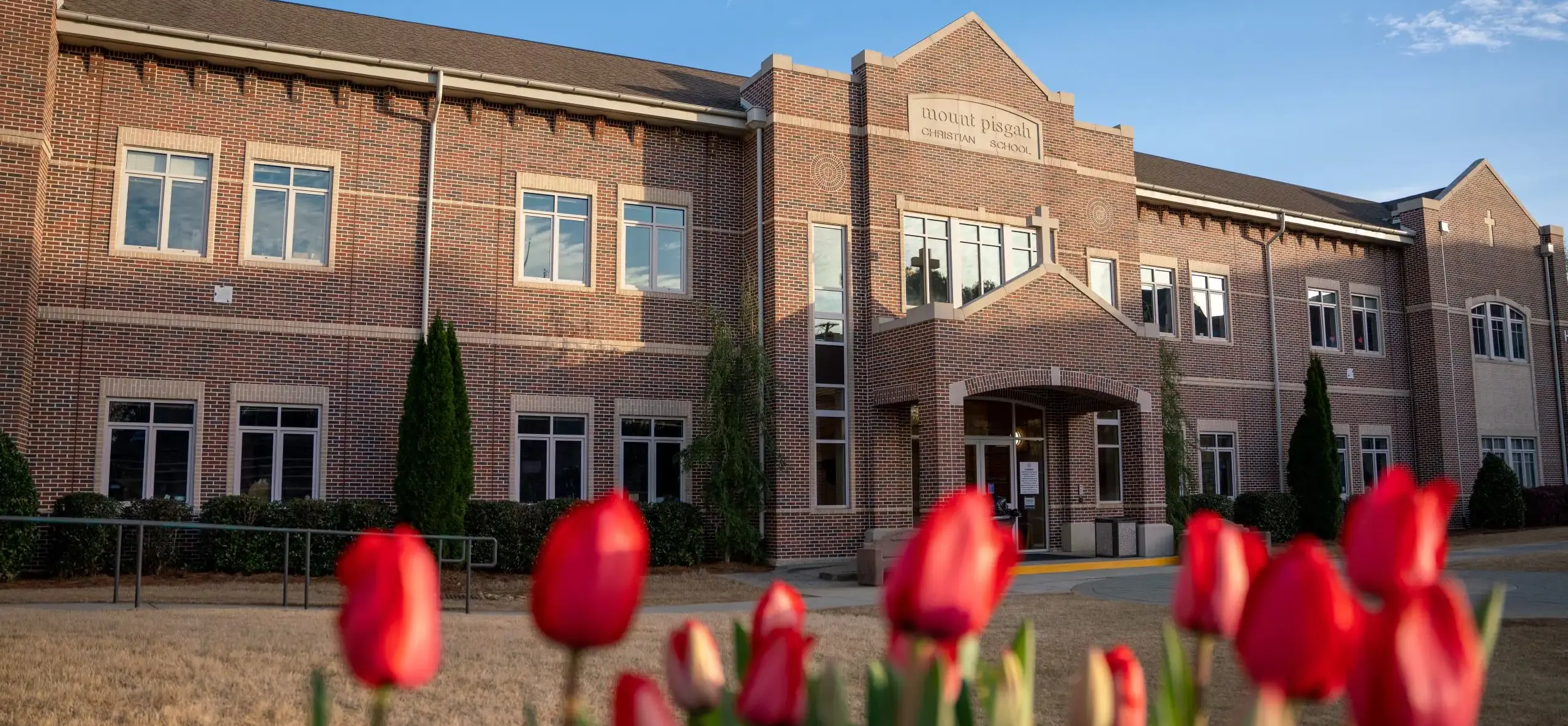
In grades 5-8, the MPCS curriculum makes connections to God, Biblical truths, and a larger Christian worldview.
Students are empowered to think critically and creatively and to act with courage and compassion. Courses are carefully aligned vertically and horizontally to ensure a robust and well-rounded education.
| MATH |
|---|
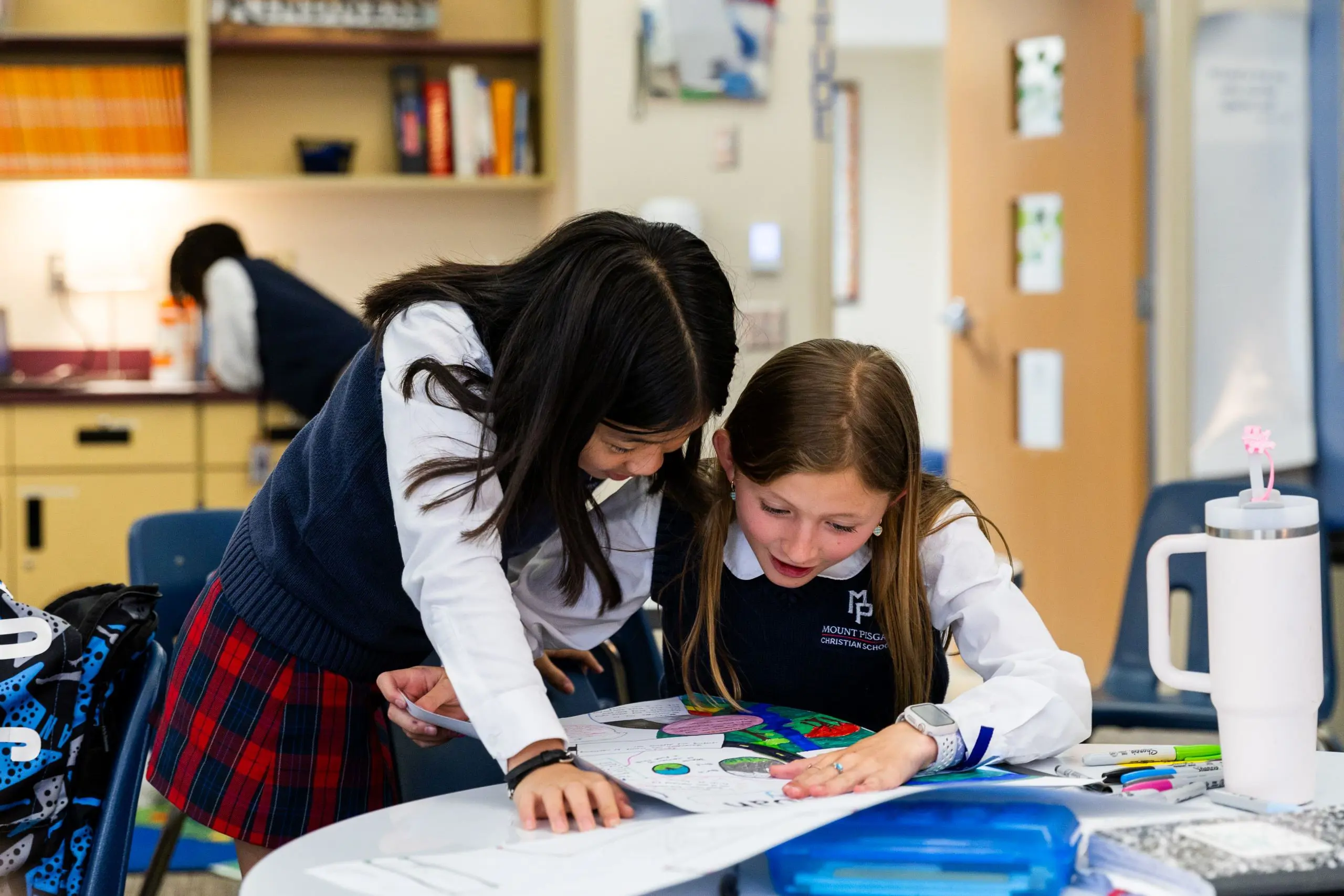
| Fifth Grade Mathematics builds a strong foundation in number sense, computational fluency, and mathematical reasoning while preparing students for middle school mathematics. Students begin with place value, numerical expressions, and algebraic thinking before applying these concepts to volume and measurement. They then develop conceptual understanding and fluency with adding, subtracting, multiplying, and dividing fractions and decimals, concluding the year with geometry. Through hands-on investigations, collaborative learning, and real-world problem solving, students build confidence, explain their mathematical reasoning, and apply their learning to increasingly complex situations. |
| ENGLISH LANGUAGE ARTS |
| This course is designed to inspire a love for language and build confidence and fluency as readers and writers. Students focus on the development of cross-curricular reading comprehension while also focusing on writing, grammar, and vocabulary. Students learn to visualize, ask higher-level thinking questions, make inferences, determine main ideas, summarize, synthesize, and make text-to-text, Biblical, and real-life connections. The class will include elements from Collaborative Classroom and Jane Schaffer writing program, which is designed as a scaffolding technique to foster and enhance the clarity and organization of student writing. |
| BIBLE |
|
This course is an overview of scripture and will survey the Old Testament in the fall and the New Testament in the spring. Students will read and interact daily with God’s Word, learning to identify and understand main characters, concepts, and themes. They will learn to dive in and examine details (what exactly is going on here?) as well as step back to consider the overarching significance of each passage (what does this say about God and his plan?). The narrative format of the class builds from creation and the chosen people of Israel to the grand climax of Christ’s coming to die and resurrect in order to save humanity. The course will conclude with practical application of how to live in light of this good news until Jesus returns. Throughout the course, students will have opportunities to consider and apply the truth of scripture to their own lives as they develop a faith walk of their own. |
| ANCIENT WORLD HISTORY |
| Ancient World History introduces students to the major civilizations, cultures, and ideas of the ancient world. Students explore how geography, belief systems, leadership, economics, and cultural exchange shaped ancient societies and their connections over time. Through maps, nonfiction readings, source analysis, discussion, writing, and collaborative inquiry, students build historical thinking skills that help them ask thoughtful questions, use evidence, compare perspectives, and explain change over time. Students also consider how history can help them grow in wisdom, character, and service to others, while regular nonfiction reading and writing prompts strengthen comprehension, evidence-based writing, and analytical thinking. |
| DISCOVERING SCIENCE |
|
Fifth-grade science is a general science course where students will investigate Earth, Life, and Physical science concepts. The course is designed to provide an engaging discovery experience as students explore the various aspects of these content strands. Students will be empowered to think critically and creatively while being encouraged to act with courage and compassion -- all for the purpose of equipping them to have a positive impact in our ever-changing world. The enduring understandings will be connected to God, Biblical Truths, and/or a larger Christian worldview. Students will have opportunities to discover these concepts through hands-on, inquiry-based activities. Science also includes our Coding with Color curriculum as part of the school's STEAM initiative. |

| MATH |
|---|
| This course meets and in many instances exceeds the standards set forth by national and state standards for the sixth-grade year. The sixth grade standards are arranged into units that will extend their knowledge and understanding of elementary topics into applicable skills as they transition into upper grades. The Standards for Mathematical Practice are a key component as they are applied in each course to equip students in making sense of problems and building a set of tools they can use in real-world situations. The elementary grades focused on concepts, skills, and problem-solving related to addition and subtraction, multiplication and division of whole numbers, and fractions. In grade 6, the focus is on ratios and proportional relationships, and early algebraic expressions and equations. |
| READING And Writing |
|
Reading - Sixth Grade Reading is an interactive process that involves thinking, questioning, discussing, rereading, and responding to texts. In Making Meaning lessons, carefully selected nonfiction and fiction read-aloud texts provide a platform for rich discussions as students encounter increasingly complex texts and build vocabulary. Lessons intentionally integrate academics with social skill development, creating an environment where students learn to collaborate, agree, and disagree respectfully and take responsibility for their own learning. Writing - We use the Jane Schaffer writing program, which is designed as a scaffolding technique to foster and enhance the clarity and organization of student writing. Students often struggle with the “blank page” and the Schaffer structure offers them a tangible and straightforward basis for clear, concise and insightful writing. The Schaffer format also provides for a common language to be shared across the curriculum and is meant to be used in every subject where writing is required. In middle school and high school, this common language is especially beneficial for students and teachers. Grammar skills are enhanced in a separate class. |
| BIBLE |
| In this course, students will explore in an in-depth study on the life of Jesus Christ. The first half of the course will focus on a scriptural study of his nature and character, authority, ministry, and sacrificial atonement for the sins of humanity. The second half of the course will consider how to respond to the good news of Jesus Christ, growing personally in discipleship. Students will learn basic Christian practices including methods for studying scripture, how to pray, and how to live in Christian community with one another. |
| MODERN WORLD HISTORY |
| Sixth Grade Modern World History builds on the foundation established in fifth grade by helping students further develop historical and geographical thinking skills. Students examine major developments in world history from approximately 1200 to the present, exploring how geography, culture, belief systems, trade, conflict, innovation, and political change shaped societies across regions and time periods. Through maps, nonfiction readings, source analysis, discussion, writing, and collaborative inquiry, students learn to ask thoughtful questions, evaluate evidence, compare perspectives, and explain connections and changes over time. Students also consider how the study of history can help them grow in wisdom, perspective, character, and responsible engagement with the world around them. |
| EARTH SCIENCE |
| Science consists of a way of thinking and investigating, as well as a growing body of knowledge about the natural world. This course provides an engaging discovery experience as students explore the universe, bodies of water, weather, and geology. Students will be encouraged to consider all of this content in terms of the value beyond the classroom. Students will also explore Animation as a way to demonstrate mastery in this course and others. |
| MATH |
|---|
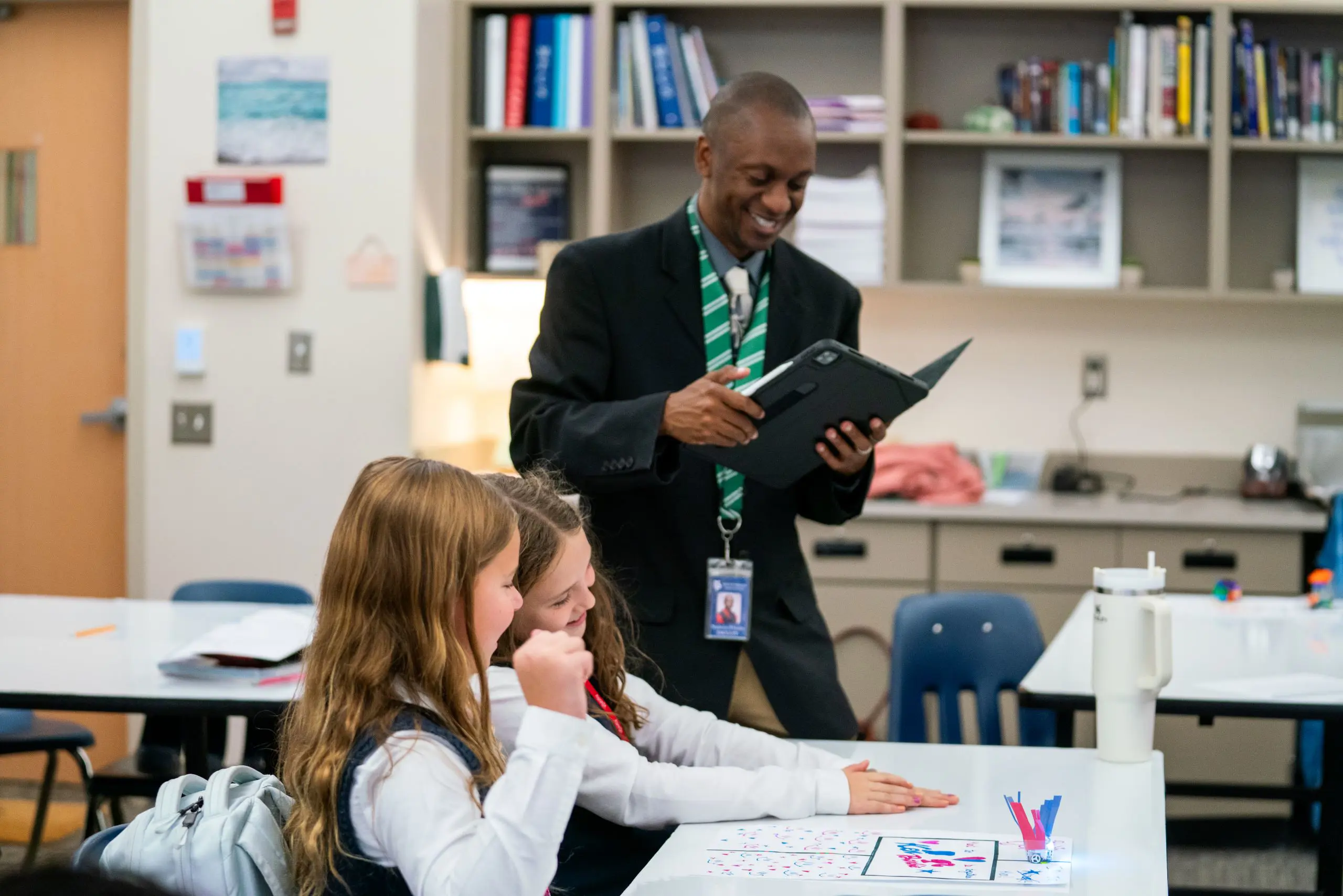
| 7th Grade Math builds on the number sense and operational skills students have developed since kindergarten, with strong emphasis on operations with rational numbers that carries throughout the year. Students deepen their algebraic thinking by solving two-step equations and inequalities, explore theories of similarity through geometry, examine relationships between numbers through ratios and rates, and draw inferences about a population from random sampling. |
| PRE-ALGEBRA ADVANCED |
| Pre-Algebra Advanced draws on 7th- and 8th-grade mathematics standards to prepare students for Algebra I, with strong emphasis on operations with rational numbers that carries throughout the year. Students deepen their algebraic thinking by solving multi-step equations and inequalities, explore theories of congruence and similarity through geometry, examine relationships between numbers through ratios and slope, and draw inferences about a population from random sampling. |
| ENGLISH LANGUAGE ARTS |
| Mount Pisgah’s 7th grade English Language Arts curriculum combines reading and writing disciplines in the same class period, emphasizing the importance of creating community spaces where students can learn and collaborate with each other. Through reading lessons, students develop comprehension and self-monitoring strategies that proficient readers use to make sense of texts. Because reading is an interactive process that involves thinking, questioning, discussing, rereading, and responding to texts, the learning community is critical. Carefully selected nonfiction and fiction texts provide a platform for rich discussions as students encounter increasingly complex texts and build their vocabularies. Lessons intentionally integrate academics with social and emotional skill development, creating an environment in which students learn to collaborate, agree and disagree respectfully, and take responsibility for their own learning. The focus of writing is “analytical response to literature”; students become proficient at applying critical thinking skills to their written work. They are taught to identify/closely examine concrete detail in texts, provide thoughtful commentary, weave these details and commentaries together, and shape their written work to create their own voices and styles. Whether responding to literature with argumentative, expository, or narrative writing, the following steps will be followed: guided writing, class collaboration, small group writing, and independent writing. |
| US HISTORY |
| U.S. History builds on students’ earlier study of American history by examining the major events, ideas, people, and turning points that shaped the United States. Students analyze the growth of and challenges to freedom, the changing role of the United States in the world, and the development of American economic and civic life. Through maps, primary and secondary sources, nonfiction readings, discussion, research, writing, and collaborative inquiry, students strengthen their ability to locate, analyze, and synthesize information, evaluate multiple perspectives, support claims with evidence, and explain change over time. Students also consider how the study of U.S. history can help them grow as informed citizens who act with wisdom, character, and responsibility. |
| LIFE SCIENCE |
| Seventh-grade students will keep logs of their observations, use those observations to analyze data, determine patterns in the data, create and/or read charts and graphs to represent the patterns they see and find more than one way to translate their findings in order to explain relationships between those patterns. Students will use this process to explain the diversity and classification of living organisms, how they reproduce and how inherited traits are passed from parents to their offspring. They will create and use different models to exhibit different levels within body systems. They will use prior knowledge about ecosystems to determine how matter and energy cycle through an ecosystem. They will explain the diversity of life using the ideas of natural selection. |
| BIBLE |
| This course is an exploration in biblical wisdom and foolishness. Students will learn about these concepts through Solomon’s writings (namely, Proverbs), as well as the books of Esther and Job, and the letter from James (the New Testament companion to Proverbs). Wise Up is a practical course that will teach students the value of employing wisdom in relationships with friends and family and the pivotal need for discerning truth in a complex world. To conclude this course, students will take part in a vibrant study of the historic Ten Boom Family via the novel The Hiding Place to analyze the costs and benefits of living out God’s wisdom in uncertain times. |

| MATH / PRE-ALGEBRA |
|---|
| 8th-grade mathematics is the last in a 9-year sequence of integrated mathematics courses focusing on a variety of mathematics topics. In Grade 8, instructional time should focus on three critical areas: (1) formulating and reasoning about expressions and equations, including modeling an association in bivariate data with a linear equation, and solving linear equations and systems of linear equations; (2) grasping the concept of a function and using functions to describe quantitative relationships; (3) analyzing two- and three-dimensional space and figures using distance, angle, similarity, and congruence, and understanding and applying the Pythagorean Theorem. |
| ALGEBRA I ADVANCED |
| Algebra I Advanced is the first course in a sequence of three required courses designed to ensure career and college readiness. The fundamental purpose of Algebra I is to formalize and extend the mathematics that students learned in the earlier grades. Students will deepen and extend their understanding of functions and the relationships between quantities by comparing and contrasting linear, quadratic, and exponential phenomena. The Mathematical Practice Standards apply throughout each unit and, together with the content standards, prescribe that students experience mathematics as a coherent, useful, and logical subject that makes use of their ability to make sense of problem situations. |
| ENGLISH LANGUAGE ARTS |
| Students will explore and understand the past, present, and future through literature and writing in this course. By reading various genres of literature, students will broaden, relate to, and share each other’s perspectives. Genre units immerse students in grammar and writing by hearing, reading, and discussing exemplary writing examples in each genre. Writing instruction utilizes the Jane Schaffer writing program, which is designed as a scaffolding technique to foster and enhance the clarity and organization of student writing. |
| ENGLISH LANGUAGE ARTS |
| This course combines reading and writing disciplines by emphasizing the importance of creating a community where students can learn and share. By reading units that include nonfiction and fiction texts, students learn comprehension and self-monitoring strategies that proficient readers use to make sense of texts. Writing instruction utilizes the Jane Schaffer writing program, which is designed as a scaffolding technique to foster and enhance the clarity and organization of student writing. Students publish argumentative, narrative, and informative pieces throughout the year. |
| THE UNITED STATES CIVIC AND COMPARATIVE GOVERNMENT |
| United States Civics and Comparative Government introduces students to the foundations, principles, structures, and functions of American government while comparing the United States system with other forms of government around the world. Students examine constitutional principles, civic rights and responsibilities, political institutions, citizenship, and the ways governments reflect different values, histories, and priorities. Through discussion, nonfiction readings, source analysis, case studies, simulations, writing, and collaborative inquiry, students strengthen their ability to analyze political ideas, compare systems, evaluate evidence, and explain how government decisions affect individuals and communities. Students also consider how the study of civics can help them grow as informed, engaged, and responsible citizens who act with wisdom, character, and discernment. |
| PHYSICAL SCIENCE |
| Using an inductive approach to science education, this course provides an atmosphere in which students can continue to learn to explore the world of science through a variety of activities. By incorporating differentiated classroom instruction, class discussion, technology, and lab activities, students will become even more familiar with experimentation and the scientific method, manipulating scientific equipment in lab settings, and analyzing and communicating scientific data. The topics covered in this course include laws of energy, motion, and gravity, states and classification of matter, an introduction to chemistry and chemical reactions, electricity and magnetism, electromagnetic and sound waves, and energy resources. Throughout the year students are required to: practice safety in lab procedures, develop science processing skills, establish a working vocabulary of science terms, explore science concepts utilizing reference and technological resources, and develop an appreciation of all God’s creation through scientific theory. |
| BIBLE - LEADERSHIP |
|
This course weaves the study of biblical worldview together with the study of Christian leadership. The course will be an ongoing examination of various worldviews alongside a survey of godly leadership traits, with the goal of learning how to identify biblical truth and lead others toward it. Students will use John Maxwell’s 21 Qualities of Leaders in the Bible to analyze biblical figures who demonstrated leadership, to discuss how to stand for truth in an ever-changing world, and to be challenged on how to grow personally in a student’s area of influence. Students will learn about historical Christian leaders and watch films related to the leadership traits being studied. Units will conclude with a project that analyzes the implementation of those traits in a real-life setting. Throughout the course, students will build a portfolio of profile pages highlighting known or historical leaders. As a means of practical application, students will be given the opportunity to implement leadership skills through an ongoing mentor partnership with the children of the Murray Academy (PreK3-4) on campus. |